Showing posts with label Digital instrument clusters. Show all posts

Keeping it fresh for 35 years

By Megan Alink, Director of Marketing Communications for Automotive

Recently, my colleagues Paul Leroux and Matt Young showed off a shiny new infographic that enlightens readers to the many ways they encounter QNX-based systems in daily life (here and here). After three-and-a-half decades in business we’ve certainly been around the block a time or two, and you might think things are getting a bit stale. As the infographic shows, that couldn’t be further from the truth here at QNX. From up in the stars to down on the roads; in planes, trains, and automobiles (and boats too); whether you’re mailing a letter or crafting a BBM on your BlackBerry smartphone, the number and breadth of applications in which our customers deploy QNX technology is simply astounding.

For those who like some sound with their pictures, we also made a video to drive home the point that, wherever you are and whatever you do, chances are you’ll encounter a little QNX. Check it out:


Long time, no see: Catching up with the QNX CAR Platform

By Megan Alink, Director of Marketing Communications for Automotive

It’s a fact — a person simply can’t be in two places at one time. I can’t, you can’t, and the demo team at QNX can’t (especially when they’re brainstorming exciting showcase projects for 2016… but that’s another blog. Note to self.) So what’s a QNX-loving, software-admiring, car aficionado to do when he or she has lost touch and wants to see the latest on the QNX CAR Platform for Infotainment? Video, my friends.

One of the latest additions to our QNX Cam YouTube channel is an update to a video made just over two and a half years ago, in which my colleague, Sheridan Ethier, took viewers on a feature-by-feature walkthrough of the QNX CAR Platform. Now, Sheridan’s back for another tour, so sit back and enjoy a good, old-fashioned catch-up with what’s been going on with our flagship automotive product (with time references, just in case you’re in a bit of a hurry).

Sheridan Ethier hits the road in the QNX reference vehicle based on a modified Jeep Wrangler, running the latest QNX CAR Platform for Infotainment.

We kick things off with a look at one of the most popular elements of an infotainment system — multimedia. Starting around the 01:30 mark, Sheridan shows how the QNX CAR Platform supports a variety of music formats and media sources, from the system’s own multimedia player to a brought-in device. And when your passenger is agitating to switch from the CCR playlist on your MP3 device to Meghan Trainor on her USB music collection, the platform’s fast detection and sync time means you’ll barely miss a head-bob.

The QNX CAR Platform’s native multimedia player — the “juke box” — is just one of many options for enjoying your music.

About five minutes in, we take a look at how the QNX CAR Platform implements voice recognition. Whether you’re seeking out a hot latté, navigating to the nearest airport, or calling a co-worker to say you’ll be a few minutes late, the QNX CAR Platform lets you do what you want to do while doing what you need to do — keeping your hands on the wheel and your eyes on the road. Don’t miss a look at concurrency (previously discussed here by Paul Leroux) during this segment, when Sheridan runs the results of his voice commands (multimedia, navigation, and a hands-free call) smoothly at the same time.

Using voice recognition, users can navigate to a destination by address or point of interest description (such as an airport).

At eight minutes, Sheridan tells us about one of the best examples of the flexibility of the QNX CAR Platform — its support for application environments, including native C/C++, Qt, HTML5, and APK for running Android applications. The platform’s audio management capability makes a cameo appearance when Sheridan switches between the native multimedia player and the Pandora HTML5 app.

Pandora is just one of the HTML5 applications supported by the QNX CAR Platform.

As Sheridan tells us (at approximately 12:00), the ability to project smartphone screens and applications into the vehicle is an important trend in automotive. With technologies like MirrorLink, users can access nearly all of the applications available on their smartphone right from the head unit.

Projection technologies like MirrorLink allow automakers to select which applications will be delivered to the vehicle’s head unit from the user’s connected smartphone. 

Finally, we take a look at two interesting features that differentiate the QNX CAR Platform — last mode persistence (e.g. when the song you were listening to when you turned the car off starts up at the same point when you turn the car back on) and fastboot (which, in the case of QNX CAR, can bring your backup camera to life in 0.8 seconds, far less than the NHTSA-mandated 2 seconds). These features work hand-in-hand to ensure a safer, more enjoyable, more responsive driving experience.

Fastboot in 0.8 seconds means that when you’re ready to reverse, your car is ready to show you the way.

Interested in learning more about the QNX CAR Platform for Infotainment? Check out Paul Leroux’s blog on the architecture of this sophisticated piece of software. To see QNX CAR in action, read Tina Jeffrey’s blog, in which she talks about how the platform was implemented in the reimagined QNX reference vehicle for CES 2015.

Check out the video here:


Hypervisors, virtualization, and taking control of your safety certification budget

A new webinar on how virtualization can help you add new technology to existing designs.

First things first: should you say “hypervisor” or “virtual machine monitor”? Both terms refer to the same thing, but is one preferable to the other?

Hypervisor certainly has the greater sex appeal, suggesting it was coined by a marketing department that saw no hope in promoting a term as coldly technical as virtual machine monitor. But, in fact, hypervisor has a long and established history, dating back almost 50 years. Moreover, it was coined not by a marketing department, but by a software developer.

“Hypervisor” is simply a variant of “supervisor,” a traditional name for the software that controls task scheduling and other fundamental operations in a computer system — software that, in most systems, is now called the OS kernel. Because a hypervisor manages the execution of multiple OSs, it is, in effect, a supervisor of supervisors. Hence hypervisor.

No matter what you call it, a hypervisor creates multiple virtual machines, each hosting a separate guest OS, and allows the OSs to share a system’s hardware resources, including CPU, memory, and I/O. As a result, system designers can consolidate previously discrete systems onto a single system-on-chip (SoC) and thereby reduce the size, weight, and power consumption of their designs — a trinity of benefits known as SWaP.

That said, not all hypervisors are created equal. There are, for example, Type 1 “bare metal” hypervisors, which run directly on the host hardware, and Type 2 hypervisors, which run on top of an OS. Both types have their benefits, but Type 1 offers the better choice for any embedded system that requires fast, predictable response times — most safety-critical systems arguably fall within this category.

The QNX Hypervisor is an example of a Type 1 “bare metal” hypervisor.


Moreover, some hypervisors make it easier for the guest OSs to share hardware resources. The QNX Hypervisor, for example, employs several technologies to simplify the sharing of display controllers, network connections, file systems, and I/O devices like the I2C serial bus. Developers can, as a result, avoid writing custom shared-device drivers that increase testing and certification costs and that typically exhibit lower performance than field-hardened, vendor-supplied drivers.

Adding features, without blowing the certification budget
Hypervisors, and the virtualization they provide, offer another benefit: the ability to keep OSs cleanly isolated from each other, even though they share the same hardware. This benefit is attractive to anyone trying to build a safety-critical system and reduce SWaP. Better yet, the virtualization can help device makers add new and differentiating features, such as rich user interfaces, without compromising safety-critical components.

That said, hardware and peripheral device interfaces are evolving continuously. How can you maintain compliance with safety-related standards like ISO 26262 and still take advantage of new hardware features and functionality?

Enter a new webinar hosted by my inimitable colleague Chris Ault. Chris will examine techniques that enable you to add new features to existing devices, while maintaining close control of the safety certification scope and budget. Here are some of the topics he’ll address:

  • Overview of virtualization options and their pros and cons
     
  • Comparison of how adaptive time partitioning and virtualization help achieve separation of safety-critical systems
     
  • Maintaining realtime performance of industrial automation protocols without directly affecting safety certification efforts
     
  • Using Android applications for user interfaces and connectivity

Webinar coordinates:
Exploring Virtualization Options for Adding New Technology to Safety-Critical Devices
Time: Thursday, March 5, 12:00 pm EST
Duration: 1 hour
Registration: Visit TechOnLine

QNX-powered Audi Virtual Cockpit shortlisted for MWC’s Global Mobile Awards

By Lynn Gayowski

2015 has just started and the QNX auto team is already off to the races. It was only last month at CES that the digital mirrors in our 2015 technology concept car were selected as a finalist for Engadget’s Best of CES Awards, in the category for best automotive tech. Now we’re excited to share some other big, award-related news. Drum roll, please… the QNX-powered Audi virtual cockpit in the 2015 Audi TT has been shortlisted for Mobile World Congress’ prestigious Global Mobile Awards, in the category for best mobile innovation for automotive!

The 2015 Audi TT features a one-of-a-kind, innovative, and just plain awesome, instrument cluster — the Audi virtual cockpit — powered by the QNX operating system. With the Audi virtual cockpit, everything is in view, directly in front of the driver. All the functions of a conventional instrument cluster and a center-mounted head unit are blended into a single, highly convenient, 12.3" display. This approach allows users to interact with their music, navigation, and vehicle information in a simple, streamlined fashion. As you may recall, the QNX-powered Audi virtual cockpit also took home first place in CTIA’s Hot for the Holidays Awards late last year.

Props also to our BlackBerry colleagues, who received 2 nominations themselves for the Global Mobile Awards: BlackBerry Blend in the best mobile service or app for consumers category, and Blackberry for BBM Protected in the best security/anti-fraud product or solution category.

The winners will be announced on March 3 at the Global Mobile Awards ceremony at Mobile World Congress. We can’t wait to hit Barcelona! In the meantime, check out the video below to see the Audi virtual cockpit in action.


Have you heard about Phantom Intelligence yet?

If you haven’t, I bet you will. Phantom Intelligence is a startup that is looking to revolutionize LiDAR for automotive. I hadn’t heard of them either until QNX and Phantom Intelligence found themselves involved in a university project in 2014. They had some cool technology and are just all-around good guys, so we started to explore how we could work together at CES 2015. One thing led to another and their technology was ultimately featured in both the QNX reference vehicle and the new QNX technology concept car.

I knew little about LiDAR at the beginning of the partnership. But as I started to ramp up my knowledge I learned that LiDAR can provide valuable sensor input into ADAS systems. Problem is, LiDAR solutions are big, expensive, and have not, for the most part, provided the kind of sensitivity and performance that automakers look for.

Phantom Intelligence is looking to change all this with small, cost-effective LiDAR systems that can detect not just metal, but also people (handy if you are crossing the street and left your Tin Man costume at home) and that are impervious to inclement weather. As a frequent pedestrian this is all music to my ears.

I am still in no way qualified to offer an intelligent opinion on the pros and cons of competing LiDAR technology so I’m just going on the positive feedback I heard from customers and other suppliers into the ADAS space at CES. Phantom turned out to be one of the surprise hits this year and they are just getting started. That’s why I think you will be hear more about them soon.


Both QNX vehicles showcased at CES 2015 use a LiDAR system from Phantom Intelligence to detect obstacles on the road ahead.

New to 26262? Have I got a primer for you

Driver error is the #1 problem on our roads — and has been since 1869. In August of that year, a scientist named Mary Ward became the first person to die in an automobile accident, after being thrown from a steam-powered car. Driver error was a factor in Mary’s death and, 145 years later, it remains a problem, contributing to roughly 90% of motor vehicle crashes.

Can ADAS systems mitigate driver error and reduce traffic deaths? The evidence suggests that, yes, they help prevent accidents. That said, ADAS systems can themselves cause harm, if they malfunction. Imagine, for example, an adaptive cruise control system that underestimates the distance of a car up ahead. Which raises the question: how can you trust the safety claims for an ADAS system? And how do you establish that the evidence for those claims is sufficient?

Enter ISO 26262. This standard, introduced in 2011, provides a comprehensive framework for validating the functional safety claims of ADAS systems, digital instrument clusters, and other electrical or electronic systems in production passenger vehicles.

ISO 26262 isn’t for the faint of heart. It’s a rigorous, 10-part standard that recommends tools, techniques, and methodologies for the entire development cycle, from specification to decommissioning. In fact, to develop a deep understanding of 26262 you must first become versed in another standard, IEC 61508, which forms the basis of 26262.

ISO 26262 starts from the premise that no system is 100% safe. Consequently, the system designer must perform a hazard and risk analysis to identify the safety requirements and residual risks of the system being developed. The outcome of that analysis determines the Automotive Safety Integrity Level (ASIL) of the system, as defined by 26262. ASILs range from A to D, where A represents the lowest degree of hazard and D, the highest. The higher the ASIL, the greater the degree of rigor that must be applied to assure the system avoids residual risk.

Having determined the risks (and the ASIL) , the system designer selects an appropriate architecture. The designer must also validate that architecture, using tools and techniques that 26262 either recommends or highly recommends. If the designer believes that a recommended tool or technique isn’t appropriate to the project, he or she must provide a solid rationale for the decision, and must justify why the technique actually used is as good or better than that recommended by 26262.

The designer must also prepare a safety case. True to its name, this document presents the case that the system is sufficiently safe for its intended application and environment. It comprises three main components: 1) a clear statement of what is claimed about the system, 2) the argument that the claim has been met, and 3) the evidence that supports the argument. The safety case should convince not only the 26262 auditor, but also the entire development team, the company’s executives, and, of course, the customer. Of course, no system is safe unless it is deployed and used correctly, so the system designer must also produce a safety manual that sets the constraints within which the product must be deployed.

Achieving 26262 compliance is a major undertaking. That said, any conscientious team working on a safety-critical project would probably apply most of the recommended techniques. The standard was created to ensure that safety isn’t treated as an afterthought during final testing, but as a matter of due diligence in every stage of development.

If you’re a system designer or implementer, where do you start? I would suggest “A Developer’s View of ISO 26262”, an article recently authored by my colleague Chris Hobbs and published in EE Times Automotive Europe. The article provides an introduction to the standard, based on experience of certifying software to ISO 26262, and covers key topics such as ASILs, recommended verification tools and techniques, the safety case, and confidence from use.

I also have two whitepapers that may prove useful: Architectures for ISO 26262 systems with multiple ASIL requirements, written by my colleague Yi Zheng, and Protecting software components from interference in an ISO 26262 system, written by Chris Hobbs and Yi Zheng.

Now with ADAS: The revamped QNX reference vehicle

Tina Jeffrey
Since 2012, our Jeep has showcased what QNX technology can do out of the box. We decided it was time to up the ante...

I walked into the QNX garage a few weeks ago and did a double take. The QNX reference vehicle, a modified Jeep Wrangler, had undergone a major overhaul both inside and out — and just in time for 2015 CES.

Before I get into the how and why of the Jeep’s metamorphosis, here’s a glimpse of its newly refreshed exterior. Orange is the new gray!


The Jeep debuted in June 2012 at Telematics Detroit. Its purpose: to show how customers can use off-the-shelf QNX products, like the QNX CAR Platform for Infotainment and QNX OS, to build a wide range of custom infotainment systems and instrument clusters, using a single code base.

From day one, the Jeep has been a real workhorse, making appearances at numerous events to showcase the latest HMI, navigation, speech recognition, multimedia, and handsfree acoustics technologies, not to mention embedded apps for parking, internet radio streaming, weather, and smartphone connectivity. The Jeep has performed dependably time and time again, and now, in an era where automotive safety is top of mind, we’ve decided to up the ante and add leading-edge ADAS technology built on the QNX OS.

After all, what sets the QNX OS apart is its proven track record in safety-certified systems across market segments — industrial, medical, and automotive. In fact, the QNX OS for Automotive Safety is certified to the highest level of automotive functional safety: ISO 26262, ASIL D. Using a pre-certified OS component is key to the overall integrity of an automotive system and makes system certification much easier.

The ultimate (virtual) driving experience
How better to showcase ADAS in the Jeep, than by a virtual drive? At CES, a 12-foot video screen in front of the Jeep plays a pre-recorded driving scene, while the onboard ADAS system analyzes the scene to detect lane markers, speed signs, and preceding vehicles, and to warn of unintentional lane departures, excessive speed, and imminent crashes with vehicles on the road ahead. Onboard computer vision algorithms from Itseez process the image frames in real time to perform these functions simultaneously.

Here’s a scene from the virtual drive, in which the ADAS system is tracking lane markings and has detected a speed-limit sign:


If the vehicle begins to drift outside a lane, the steering wheel provides haptic feedback and the cluster displays a warning:


The ADAS system includes Elektrobit EB Assist eHorizon, which uses map data with curve-speed information to provide warnings and recommendations, such as reducing your speed to navigate an upcoming curve:


The Jeep also has a LiDAR system from Phantom Intelligence (formerly Aerostar) to detect obstacles on the road ahead. The cluster displays warnings from this system, as well as warnings from the vision-based collision-detection feature. For example:


POSTSCRIPT:
Here’s a short video of the virtual drive, taken at CES by Brandon Lewis of Embedded Computing Design, in which you can see curve-speed warnings and lane-departure warnings:


Fast-boot camera
Rounding out the ADAS features is a rear-view camera demo that can cold boot in 0.8 seconds on a Texas Instruments Jacinto 6 processor. As you may recall, NHTSA has mandated that, by May 2018, most new vehicles must have rear-view technology that can display a 10-by-20 foot area directly behind the vehicle; moreover, the display must appear no more than 2 seconds after the driver throws the vehicle into reverse. Backup camera and other fastboot requirements such as time-to-last-mode audio, time-to-HMI visible, and time-to-fully-responsive HMI are critically important to automakers. Be sure to check out the demo — but don’t blink or you’ll miss it!

Full-featured infotainment
The head unit includes a full-featured infotainment system based on the QNX CAR Platform for Infotainment and provides information such as weather, current song, and turn-by-turn directions to the instrument cluster, where they’re easier for the driver to see.


Infotainment features include:

Qt-based HMI — Can integrate other HMI technologies, including Elektrobit EB Guide and Crank Storyboard.

Natural language processing (NLP) — Uses Nuance’s Vocon Hybrid solution in concert with the QNX NLP technology for natural interaction with infotainment functions. For instance, if you ask “Will I need a jacket later today?”, the Weather Network app will launch and provide the forecast.

EB street director — Provides embedded navigation with a 3D map engine; the map is synched up with the virtual drive during the demo.

QNX CAR Platform multimedia engine — An automotive-hardened solution that can handle:
  • audio management for seamless transitions between all audio sources
  • media detection and browsing of connected devices
  • background synching of music for instant media playback — without the need for the synch to be completed

Support for all smartphone connectivity options — DLNA, MTP, MirrorLink, Bluetooth, USB, Wi-Fi, etc.

On-board application framework — Supports Qt, HTML5, APK (for Android apps), and native OpenGL ES apps. Apps include iHeart, Parkopedia, Pandora, Slacker, and Weather Network, as well as a Settings app for phone pairing, over-the-air software updates, and Wi-Fi hotspot setup.

So if you’re in the North Hall at CES this week, be sure to take a virtual ride in the QNX reference vehicle in Booth 2231. Beneath the fresh paint job, it’s the same workhorse it has always been, but now with new ADAS tech automakers are thirsting for.

Volkswagen and LG Gear up with QNX

Design wins put QNX technology in a wide range of infotainment systems, instrument clusters, and ADAS solutions.

Earlier today, QNX Software Systems announced that infotainment systems powered by the QNX Neutrino OS are now shipping in several 2015 Volkswagen vehicle models, including the Touareg, Passat, Polo, Golf, and Golf GTI.

The systems include the RNS 850 GPS navigation system in the Volkswagen Touareg, which recently introduced support for 3D Google Earth maps and Google Street View. The system also offers realtime traffic information, points-of-interest search, reverse camera display, voice control, Bluetooth connectivity, rich multimedia support, four-zone climate control, a high-resolution 8-inch color touchscreen, and other advanced features.

Bird's eye view: the RNS 850 GPS navigation system for the Volkswagen Touareg SUV. Source: VW

“At Volkswagen, we believe deeply in delivering the highest quality driving experience, regardless of the cost, size, and features of the vehicle,” commented Alf Pollex, Head of Connected Car and Infotainment at Volkswagen AG. “The scalable architecture of the QNX platform is well-suited to our approach, enabling us to offer a full range of infotainment systems, from premium level to mass volume, using a single, proven software base for our Modular Infotainment Modules (MIB) and the RNS 850 system.”

QNX and LG: a proven partnership
QNX also announced that LG Electronics’ Vehicle Components (VC) Company will use a range of QNX solutions to build infotainment systems, digital instrument clusters, and advanced driver assistance systems (ADAS) for the global automotive market.

The new initiative builds on a long history of collaboration between LG and QNX Software Systems, who have worked together on successful, large-volume telematics production programs. For the new systems, QNX will provide LG with the QNX CAR Platform for Infotainment, the QNX Neutrino OS, the QNX OS for Automotive Safety, and QNX Acoustics for Voice.

“QNX Software Systems has been our trusted supplier
for more than a decade... helping LG deliver millions
of high-quality systems to the world’s automakers”

— Won-Yong Hwang, LG's VC Company

“QNX Software Systems has been our trusted supplier for more than a decade, providing flexible software solutions that have helped LG deliver millions of high-quality systems to the world’s automakers,” commented Won-Yong Hwang, Director and Head of AVN development department, LG Electronics’ VC Company. “This same flexibility allows us to leverage our existing QNX expertise in new and growing markets such as ADAS, where the proven reliability of QNX Software Systems’ technology can play a critical role in addressing automotive safety requirements.”

Visit the QNX website to learn more about the Volkswagen and LG announcements.

First impressions are the most lasting

Lynn Gayowski
Lynn Gayowski
Preparations for 2015 CES in January are in full swing at QNX Software Systems, both in and out of the garage. Thus, with fond memories in mind, the time has come to graduate our 2014 technology concept car, based on a Mercedes-Benz CLA45 AMG, to a CES Car of Fame. The Mercedes will always hold a special place in my heart, as it was the first technology concept car I got to experience hands-on since joining the QNX team.

If I were to describe this concept car with one word, I would choose "user-centric". (I love how hyphens can really help in these succinct situations.) We designed the infotainment system and digital instrument cluster with a vision to help drivers interact in new and seamless ways with their vehicles. This concept car is a great example of how QNX technology can enable a more natural user experience.

As we hum a few bars of Sarah McLachlan's classic I Will Remember You, let's look back at some highlights.

The first thing that catches your eye is the matte exterior and stylish lines, exuding just a soupçon of James Bond:

QNX 2014 technology concept car - exterior

But let's get to the technology. At 21" by 7" the touch screen is a showstopper. It brings a rich, graphical interface to both driver and passenger. This is where you can really see the user-centric design, with options to control the infotainment system with the touch screen, physical buttons, a jog wheel, or voice commands:

QNX 2014 technology concept car - infotainment system

We really wanted to use the car to highlight the flexibility of the QNX CAR Platform and how customers can easily modify features using the platform's pre-integrated technologies. A great example of this is the car's navigation system. The car actually has 4 different navigation solutions installed, demonstrating how automakers can choose a solution best suited for a particular geography or language. EB Street Director is featured in this photo:

QNX 2014 technology concept car - navigation

The infotainment system may wow you, but don't forget about the cluster. The Mercedes has a dynamically reconfigurable digital instrument cluster that can display turn-by-turn directions, notifications of incoming phone calls, video from the car's front and rear cameras, as well as a tachometer, speedometer, and other virtual instruments, at a full 60 frames per second. The cluster can even notify you of incoming text messages on your phone. Simply push a steering-wheel button, and the system will read the message aloud, so you can keep your eyes on the road.

QNX 2014 technology concept car - cluster

Another cool feature is the cluster's "virtual mechanic" which lets you access vehicle info like tire pressure, brake wear, and fuel, oil, and windshield fluid levels:

QNX 2014 technology concept car - virtual mechanic

What car of the future would be complete without connectivity? A custom "key fob" app allows you to remotely access system maintenance information, control the media player, locate the car on a map, and perform a number of actions like starting the car and opening window. This cross-platform HTML5 app can run on any smartphone or tablet:

QNX 2014 technology concept car - key fob

As an overall view of the Mercedes, one of my favourite pieces is this video by Sami Haj-Assaad of AutoGuide, where he takes a look at the design and features of the car. His closing quote really sums up the innovation showcased: "The infotainment industry is going through a huge upgrade, with QNX leading the charge."


I hope you enjoyed the 2014 QNX technology concept car. Watch for the reveal of our 2015 technology concept car January 6 at CES in Las Vegas!

Japan update: ADAS, wearables, integrated cockpits, and autonomous cars

Yoshiki Chubachi
Yoshiki Chubachi
Will the joy of driving be a design criterion for tomorrow’s vehicles? It had better be.

A couple of weeks ago, QNX Software Systems sponsored Telematics Japan in Tokyo. This event offers a great opportunity to catch up with colleagues from automotive companies, discuss technology and business trends, and showcase the latest technology demos. Speaking of which, here’s a photo of me with a Japan-localized demo of the QNX CAR Platform. You can also see a QNX-based digital instrument cluster in the lower-left corner — this was developed by Three D, one of our local technology partners:


While at the event, I spoke on the panel, “Evolving ecosystems for future HMI, OS, and telematics platform development.” During the discussion, we conducted a real-time poll and asked the audience three questions:

1) Do you think having Apple CarPlay and Android Auto will augment a vehicle brand?
2) Do you expect wearable technologies to be integrated into cars?
3) If your rental car were hacked, who would you complain to?

For question 1, 32% of the audience said CarPlay and Android Auto will improve a brand; 68% didn't think so. In my opinion, this result indicates that smartphone connectivity in cars is now an expected feature. For question 2, 76% answered that they expect to see wearables integrated into cars. This response gives us a new perspective — people are looking at wearables as a possible addition to go with ADAS systems. For example, a wearable device could help prevent accidents by monitoring the driver for drowsiness and other dangerous signs. For question 3, 68% said they would complain to the rental company. Mind you, this raises the question: if your own car were hacked, who would you complain to?

Integrated cockpits
There is growing concern around safety and security as companies attempt to grow more business by leveraging connectivity in cars. The trend is apparent if you look at the number of safety- and security-related demos at various automotive shows.

Case in point: I recently attended a private automotive event hosted by Renesas, where many ADAS and integrated cockpit demos were on display. And last month, CEATEC Japan (aka the CES of Japan) featured integrated cockpit demos from companies like Fujitsu, Pioneer, Mitsubishi, Kyocera, and NTT Docomo.

For the joy of it
Things are so different from when I first started developing in-car navigation systems 20 years ago. Infotainment systems are now turning into integrated cockpits. In Japan, the automotive industry is looking at early 2020s as the time when commercially available autonomous cars will be on the road. In the coming years, the in-car environment, including infotainment, cameras and other systems, will change immensely — I’m not exactly sure what cars in the year 2020 will look like, but I know it will be something I could never have imagined 20 years ago.

A panel participant at Telematics Japan said to me, “If autonomous cars become reality and my car is not going to let me drive anymore, I am not sure what the point of having a car is.” This is true. As we continue to develop for future cars, we may want to remind ourselves of the “joy of driving” factor.

Ontario tech companies team up to target the connected car

To predict who will play a role tomorrow's connected vehicles, you need to look beyond the usual suspects.

When someone says “automobile,” what’s the first word that comes to mind? Chances are, it isn’t Ontario. And yet Ontario — the Canadian province that is home to QNX headquarters — is a world-class hub of automotive R&D and manufacturing. Chrysler, Ford, General Motors, Honda, and Toyota all have plants here. As do 350 parts suppliers. In fact, Ontario produced 2.5 million vehicles in 2012 alone.

No question, Ontario has the smarts to build cars. But to fully appreciate what Ontario has to offer, you need to look beyond the usual suspects in the auto supply chain. Take QNX Software Systems, for example. Our roots are in industrial computing, but in the early 2000s we started to offer software technology and expertise to the world’s automakers and tier one suppliers. And now, a decade later, QNX offers the premier platform for in-car infotainment, with deployments in tens of millions of vehicles.

QNX Software Systems is not alone. Ontario is home to many other “non-automotive” technology companies that are playing, or are poised to play, a significant role in creating new automotive experiences. But just who are these companies? The Automotive Parts Manufacturers Association (APMA) of Canada would like you to know. Which is why they've joined forces with QNX and other partners to build the APMA Connected Vehicle.

A showcase for Ontario technology.
The purpose of the vehicle is simple: to showcase how Ontario companies can help create the next generation of connected cars. The vehicle is based on a Lexus RX350 — built in Ontario, of course — equipped with a custom-built infotainment system and digital instrument cluster built on QNX technology. Together, the QNX systems integrate more than a dozen technologies and services created in Ontario, including gesture recognition, biometric security, emergency vehicle notification, LED lighting, weather telematics, user interface design, smartphone charging, and cloud connectivity.

Okay, enough from me. Time to nuke some popcorn, dim the lights, and hit the Play button:


QNX-powered Audi Virtual Cockpit drives home with CTIA award

Congratulations to our friends at Audi! The new Audi Virtual Cockpit, which is based on the QNX OS, has just won first prize, connected car category, in the 2014 CTIA Hot for the Holidays awards.

I’ve said it before and I’ll say it again: the Audi Virtual Cockpit is an innovative, versatile, and absolutely ravishing piece of automotive technology. But you don’t have to take my word for it — or the word of the CTIA judges, for that matter. Watch the video and see for yourself:


Created in 2009, the Hot for the Holidays awards celebrate the most desirable mobile consumer electronics products for the holiday season. The winners for this year’s awards were announced this afternoon, at the CTIA Super Mobility event in Las Vegas. Andrew Poliak of QNX Software Systems was on hand and he took this snap of the award:


Visit the CTIA website to see the full list of winners. And visit the Audi website to learn more about the Audi Virtual Cockpit.

The summer road trip of 2017 — Part I

Lynn Gayowski
Lynn Gayowski
Summer is the season for many things — ice cream, outdoor festivals, heat waves, more ice cream, and perhaps best of all, hitting the open road. 2017 is around the corner, and between now and then, automakers will introduce a bevy of new features that will make for a safer and more enjoyable summer road trip. In this two-part series, we’ll take a look at how these technologies will help transform your summer road trip.

Tunes for the road
A road trip without a soundtrack is a road trip I want no part of. I think we can all agree that a Britney Spears playlist is compulsory. Music has always been intimately connected to the driving experience (see the Highway Hi-Fi Phonograph below for proof) and it’ll be even more integrated in the cars of 2017 with fewer limits. 


The media sources that you depend on today — local drives, USB storage devices, smartphones, cloud services — will work seamlessly with your vehicle, allowing you and your passengers to enjoy any genre from any source. Conventionally constrained to your center stack, music meta-data will permeate all the screens of your car, even the instrument cluster.


And for the backseat DJs, they’ll be able to use apps on their mobile devices to control the music playing in the car, which just might make the oft-repeated passenger phrase “Can you skip to the next song? I don’t like this one,” obsolete. Of course, to minimize distraction, the driver will always maintain cabin-wide control of what’s playing, and how loud it’s playing. 

The context-aware cockpit
The road trip of years past was plotted on a paper map and required a navigator in the passenger seat; today’s passengers are relieved of these duties as navigation and route plotting have gone digital. But even with that convenience, having to divert your eyes from the road to the center stack can be a nuisance. The dashboard of 2017 will offer greater convenience with a driver centric-display that could blend navigation and digital cluster information all on one screen. These vehicles will be "context aware" and display different information depending on the environment. For instance, surround-view cameras could detect pedestrians or cyclists and provide a minimalist on-screen alert to minimize driver distraction. Similarly, the system may disable certain functionality when the driver is about to navigate a hairpin turn. If the vehicle “knows” there’s a challenge ahead related to road condition, visibility, local speed limits, traffic, or topographical information, it could display the appropriate context-relevant information to the driver. 


Staying mobile
By 2017, you’ll probably have a new smartphone and, regardless of the platform, it’ll be able to communicate with your car. Projection mode technologies will be commonplace and render your phone’s display and services onto your car’s center stack (one example is QNX-powered Audi’s MMI mobile media application framework). This integration will no doubt get even more advanced in the coming years, and with Apple’s CarPlay and Google’s Android Auto connectivity protocols taking form, your favorite apps will be as at home on your dash as they are in your hand. 


Your phone will also be able to control and monitor your car in new ways via the much-discussed, but sometimes nebulous, cloud. For instance, let’s say you find yourself at a behemoth rest stop and can’t remember the location of your car after indulging in the roadside cuisine. Your phone’s “key fob” app could tell you exactly where your car is — it could even let you check your oil and washer fluid remotely to see if your car is in shape to make it on the next of your leg of your trip. 


How is in-car technology playing a role in your current summer road trip? How do you want it to improve your future road trips? What’s your favorite road trip destination? (My personal favorite is Washington, DC
) Stay tuned here for Part II, and to our QNX_Auto Twitter account and Facebook page for weekly discussions on what 2017 has in store for your road trip.


QNX-powered 2015 Audi TT named best-connected car

Is it innovative, beautiful, versatile, or just plain cool? I haven’t quite decided, so I’m thinking it’s all of the above. The QNX-based virtual cockpit in the 2015 Audi TT is a ravishing piece of automotive technology, and it brings driver convenience to a new level by integrating everything from speed and navigation to music and handsfree calling — all in a single, user-configurable display.

It seems I’m not the only one who's impressed. Because last week, 42,500 readers of “auto motor und sport” and “CHIP” chose the Audi TT as the industry's best-connected car. In fact, Audi took top honors in several categories, including navigation, telephone integration, sound system, entertainment/multimedia, and connected car.

To get an idea of what all the fuss is about, check out our video of the Audi TT’s virtual cockpit in action. We filmed this at CES earlier this year:


For more information on the award and the Audi TT, read Audi's press release.

A cool (and connected) cluster

"The more we get connected,
Connected, connected,
The more we get connected,
The happier we’ll be."

Okay, I'll admit it, that's a little over the top. But even if connectivity can't make you happy, it can still breathe a great deal of enjoyment and productivity into your life. And when you build connectivity into devices that have previously stood alone, you open the door to all kinds of exciting possibilities. Case in point: the new digital instrument cluster for the QNX technology concept car.

Here's the cluster at a glance — click to see a bigger version:


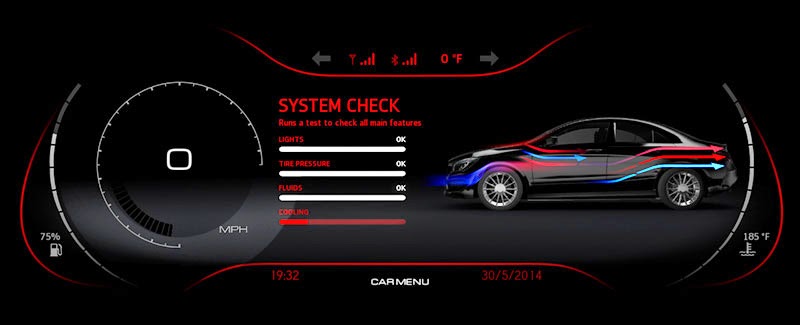
Admit it: you'd love to wrap your hands around that steering wheel. I know I would. The Mercedes CLA45 is a sweet ride, and it inspired the QNX concept team to pull out all the stops when designing the new cluster with our partner Rightware, a specialist in UI tools for cars.

Four-point check
Okay, let's hop in and take a closer look. But before we put the car in gear, did your driving instructor ever tell you to do a four-point check? You know, where you make sure your lights, brakes, and other systems are working properly? You do remember to do that, don't you? The cluster makes the task a little easier by checking lights, tire pressures, fluids, and the HVAC system automatically:


Ease off the pedal, buddy
Time to put the car in gear. But before we do, let me tell you about the Plymouth safety speedometer. Designed to curb speeding, it alerted the driver whenever he or she leaned too hard on the gas. In theory, it was a great idea. In practice, it wasn't. You see, the year was 1939. And given the limitations of 1939 technology, the Plymouth safety speedometer couldn't take driving conditions or the local speed limit into account. So the speedometer always displayed warnings at the same speeds, no matter what the speed limit.

Connectivity to the rescue! Some modern navigation systems include information on local speed limits. By connecting the digital instrumental cluster to the navigation system in the car's head unit, the concept team was able to pull this information and display it in real time on the cluster, creating a modern (and much more useful) equivalent of Plymouth's 1939 invention.

Look at the image below. You'll see the local speed limit surrounded by a thick red circle, alerting the driver that they are breaking the limit — the fulfillment of an idea that has been 75 years in the making. Mind you, this isn't the only information that the cluster pulls from the head unit. It can also display turn-by-turn directions, trip information, album art, and other content normally relegated to the center display:


Should you answer?
Oh, hold on, the cluster is alerting us to an incoming call. You can ignore it, or you can answer by pushing a button on the steering wheel. And because this is the QNX technology concept car, it's no ordinary phone call. The car is equipped with QNX Acoustics for Voice, which supports Wideband Plus speech to deliver almost four times the bandwidth of a standard narrowband call. Translation: The person on the far end of call sounds like they're sitting right next to you.


Looking back
Okay, it's been a great drive, but time to head home. And in this case, home is the QNX garage. The garage doors are pretty narrow, and you need to back in carefully, so it's great to know that the cluster also provides a convenient window for the car's rear-view camera:


Meanwhile, in the real world...
Don't make the mistake of thinking this is a Buck Rogers scenario. Because the same combination of QNX and Rightware technology is already powering innovative systems like the Audi virtual cockpit. If you haven't yet seen the Audi system in action, check it out:


Infotainment gets an upgrade

So, a few weeks ago, we invited a group of Canadian journalists to come visit the QNX garage and get a hands-on intro to our latest concept cars. Sami Haj-Assaad of AutoGuide was one of our esteemed guests, and here's his take on what he experienced:


Did you notice? The floors in the video are remarkably clean for a working garage. That's because we set loose a QNX-powered robot vacuum from Neato Robotics before the cameras started rolling. If you haven't yet seen a Neato Botvac in action, you owe it to yourself to check out this video.

If you're a visual designer, keep reading...
Would you, by any chance, be a creative, experienced, and just plain awesome visual designer? Because if you are, have I got a job for you. Right now, QNX is looking for a designer to help create its next generation of concept vehicles — and lots of other things to boot. This is a one-of-a-kind opportunity to put your mark on some very cool technology; find out more here.

Why I should have gone to CES this year

No problem, I said, I'll be happy to stay back at the office. After all, somebody has to hold down the fort while everyone is at CES, and it may as well be me.

Of course, I didn't know what Audi was bringing to the show. Because if I did, I wouldn't have been so willing to take one for the team. If you're wondering what I am talking about, it's the new user-programmable instrument cluster for the upcoming 2015 Audi TT. It's based on the QNX CAR Platform for Infotainment, and it's about the coolest thing I've seen in a car, ever — even if I haven't yet had a chance to see it in person.

Roll the tape...


My top 10 QNX Auto posts from 2013

Normally, people write this kind of post at the beginning or end of a calendar year. But as an old friend once said, “Paul defines his own kind of normal.” He may have been right, I don’t know. What I do know is that this is definitely a personal list. It consists of posts that either made me laugh, taught me something I didn’t know, or helped me see things in a new light. I hope they do the same for you.

Disclosure: I wrote a couple of the posts in question. Because, sometimes, the best way to learn about something or see it in a new light is to write about it. :-)

Okay, enough preliminaries, let’s get to it…

  • What happens when autonomous becomes ubiquitous? — One question, seventeen answers.
     
  • Top 10 lessons learned from more than a decade in automotive — When it comes to software in the car, John Wall is the man.
     
  • Protecting software components in an ISO 26262 system — Sometimes, software components can be downright delinquent.
     
  • Why doesn’t my navigation system understand me? — Big data might be important, but small data can add a personal touch.
     
  • Top 10 challenges facing the ADAS industry — For ADAS systems to be successful, a safety culture must be embedded in every organization in the supply chain. And that’s just the first challenge.
     
  • Reducing driver distraction with ICTs — Yes, mobile phones can contribute to driver distraction. But they can also help solve the problem.
     
  • A sound approach to creating a quieter ride — Paradoxically, the best way to eliminate engine noise is to generate noise.
     
  • What's the word on HTML5? — If you want to know what experts at Audi, OnStar, Gartner, Pandora, TCS, and QNX think about HTML5 in the car, this is the post with the most (videos, that is).
     
  • A matter of context — A look at how digital instrument clusters can help provide the right information, at the right time.
     
  • My top moments of 2013 — Because this reminds me of the fantastic momentum QNX is building in automotive.
     
  • HTML5 blooper reel — Because laughter.

Oops, I guess that makes 11.

In good company: QNX partner solutions at 2014 CES

Guest post by Peter McCarthy of the QNX global partnerships team

Peter McCarthy
If anyone thinks that creating an infotainment system is easy, they obviously haven’t thought about it hard enough. It is, in fact, a massive undertaking that requires seamless integration of navigation engines, voice technologies, app environments, HMI tools, Internet music services, smartphone connectivity, automotive-hardened processors — the list goes on.

No single company could possibly offer all of these technologies. And even if it could, it still wouldn’t address the needs of automakers and tier one suppliers, who need the power of choice. Any company building an infotainment system needs the flexibility to combine Navigation Engine A with Processor B and Bluetooth Solution C.

Enabling customers to enjoy such choice without worrying about integration issues is something that QNX works very hard at. For evidence, look no further than our latest technology concept car, a modified Mercedes-Benz CLA45 AMG, which debuted this week at our CES booth. The car integrates an array of partner tech, including:

Meanwhile, the head unit in our reference vehicle, also featured in the QNX booth, integrates several partner apps and holds the distinction of being the world’s first in-vehicle implementation of Qualcomm’s Snapdragon Automotive Solutions. And if that’s not enough, our booth contains demos of a navigation engine from Aisin AW and a digital instrument cluster built with HMI tools from HI Corporation.

Mind you, the action isn’t restricted to the QNX booth. Several partners have also gotten into the act and are demonstrating QNX-based systems in their CES booths and meeting rooms. For instance:

  • Elektrobit — Demonstrating a new concept electric vehicle that sports an instrument cluster and infotainment system based on the QNX Neutrino Realtime Operating System.
     
  • Freescale — Demonstrating the QNX CAR Platform for Infotainment on its i.MX 6 Applications Processors for Automotive.
     
  • Gracenote — Demonstrating how its technology can personalize the in-vehicle music experience, using a system based on the QNX Neutrino OS.
     
  • NVIDIA — Demonstrating Audi's newest infotainment system featuring the NVIDIA Tegra processor and the QNX Neutrino OS.
     
  • Qualcomm — Demonstrating the QNX CAR Platform on Snapdragon Automotive Solutions.
     
  • Red Bend Software — Demonstrating virtualization technology that runs the QNX CAR Platform and a digital instrument cluster on dual displays driven by a single processor.
     
  • Texas Instruments — Demonstrating the QNX CAR Platform running on its latest Jacinto processors

For the fully skinny on QNX partner technology at CES, I invite you to check out our press release, along with joint announcements that we have issued with Aisin AW, HERE, HI Corporation, and Qualcomm.


About Peter
When he isn't talking on oversized mobile phones, Peter McCarthy serves as director of global partnerships at QNX Software Systems, where he is responsible for establishing and fostering partnerships with technology and services companies in all of the company's target industries.